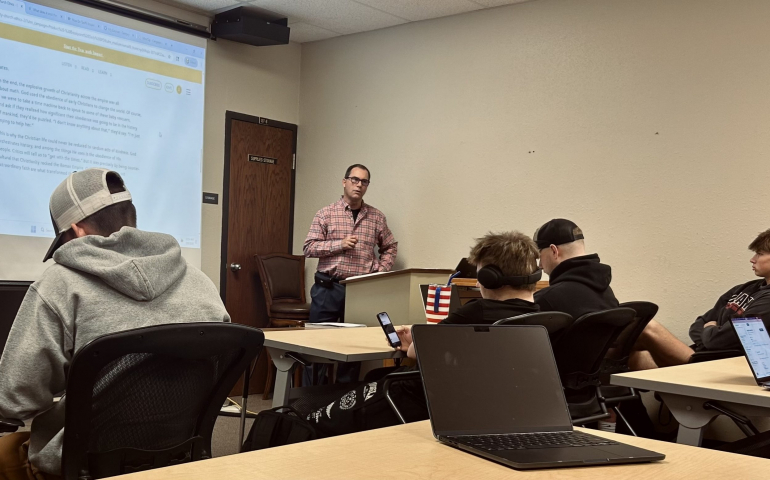
While textbooks are released every few years, the world changes daily. In a world that is changing faster than ever, SNU professors keep the classroom current by integrating real-world events into their teaching.
Assistant Professor of Business Jeff Seyfert teaches Principles of Marketing, Economics and Consumer Behavior. Because the textbook publication process can take more than a year, Seyfert explained that “the textbook content can be a little bit outdated, and so bringing current events in helps to upgrade the content and introduce more current terminology.” He incorporates articles and videos that relate to course material and assigns article reviews that students present to their peers.
Seyfert finds many of his articles through email subscriptions to business news outlets and blogs. When he discovers something relevant, he matches it with the corresponding textbook chapter and integrates it into class discussion. He encourages students to connect textbook concepts to real-world situations through their presentations. “There is no shortage of material out there,” he shared. “I look for things that illustrate what we are talking about in class, and I’m always extremely interested in what students find interesting and bring in their article reviews.”
In his marketing courses, Seyfert often incorporates discussions about ethics. Like many SNU professors, he begins class with prayer and devotion, emphasizing the Christian perspective of marketing ethics. His goal is for students to speak intelligently about current events and to live out biblical values in business both now and after graduation.
Seyfert developed this approach as a student at SNU in the 1980s. He recalled that his professor, Dr. Larry Mills, used a subscription to The Wall Street Journal in many classes. Seyfert has incorporated current events into his teaching since joining the faculty in 1990. Comparing textbook concepts to business news, he described it as “something that has been around the SNU School of Business for a very long time.” Reflecting on changes in the business world, he observed, “There has always been a fairly fast pace in the world of business, but it has just accelerated tremendously over the last 10 years. The internet and AI have moved things along extremely quickly.”
Assistant Professor of Politics and Pre-Law and Director of Debate Dennis Savill also brings current events into his classroom, often by connecting present-day issues to historical patterns. As a doctoral student at SNU, he follows the example of his professors by incorporating real-world experiences into his undergraduate teaching.
“When I am teaching history, I try to make it relevant and show students why they need to know the things we are teaching,” Savill noted. “I show that things students are learning now that happened in the 1600s and 1700s still have relevance today.” He emphasizes how history often repeats itself, pointing out similarities between past societal challenges and those facing current generations. He draws connections between earlier industrial revolutions and what many consider the fourth industrial revolution driven by artificial intelligence.
Savill integrates real-world events into assignments by encouraging students to research topics aligned with their interests and passions. He also highlights how God has worked throughout history and expressed gratitude for teaching at a university where discussions about faith are welcomed.
During the fall semester, Savill taught Communication and Leadership for Non-Profit Organizations, incorporating examples from his previous career in information technology. He guided students in navigating workplace dynamics, managing differences of opinion, asking thoughtful questions, understanding cultural differences and presenting information neutrally. He encourages students to spend a few minutes each day staying informed by reading a variety of local, national and global news sources.
Through creativity and critical thinking, SNU professors connect current events to foundational textbook concepts, ensuring students are prepared to engage thoughtfully with a rapidly changing world.
Photo credit: Trynitie Krout